
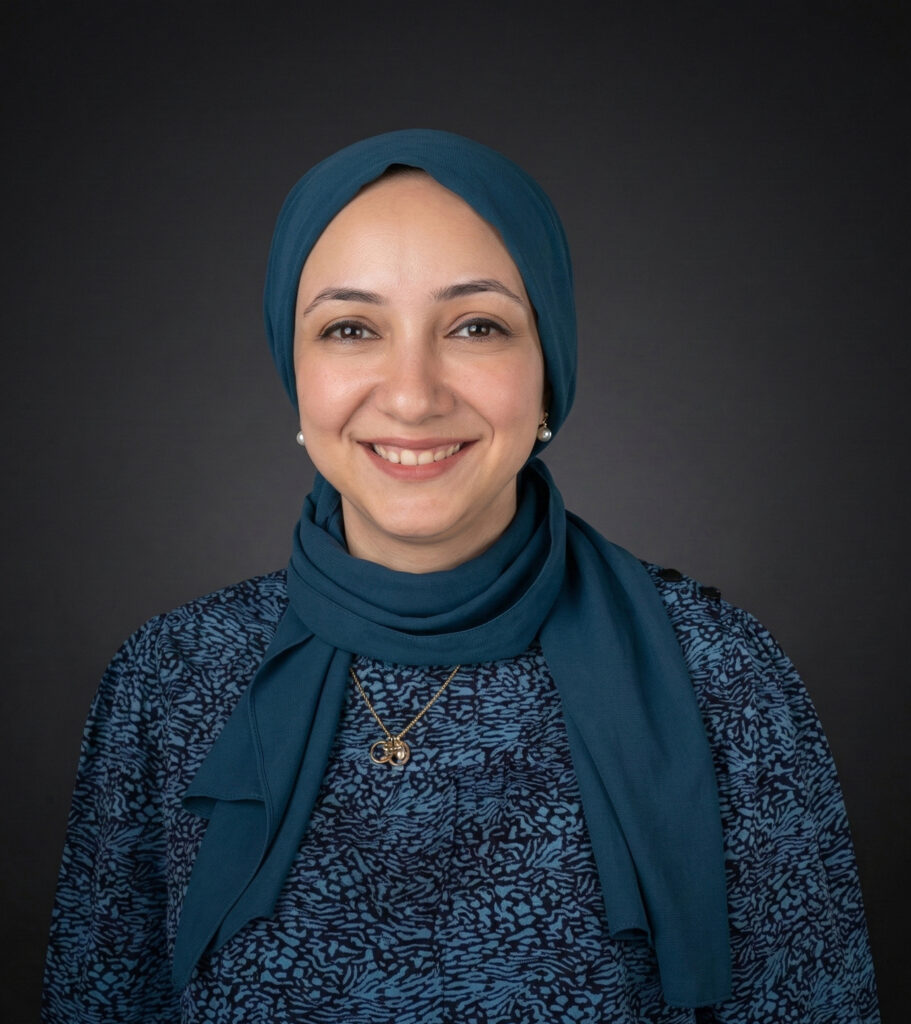
Deputy Director of Center of Genomics
Associate Professor
Email: emostafa@zewailcity.edu.eg
Office Room Number: F003A/ HB
Programs: Biomedical Sciences
Dr. Eman Badr
Biography
Dr. Eman Badr is an associate professor of Biomedical Sciences at Zewail City of Science and Technology. She also serves as deputy director of the Center for Genomics and leads the Bioinformatics and Computational Biology group. Dr. Badr earned her Ph.D. in Computer Science from Virginia Tech, USA, and holds M.Sc. and B.Sc. degrees in Computer Science from Cairo University’s Faculty of Computers and Information. Her research focuses on computational biology, machine learning, and medical imaging analysis, specifically on large-scale data problems, integrative NGS data analysis, and applying deep learning techniques to combine various data sources for classification tasks.
She is an executive committee member of the Egyptian Bioinformatics Network (BioNetMasr) and chairs the Electronics, Communication, and Information Technology Committee of the Technical Office (ECIT) at the Academy of Scientific Research and Technology (ASRT). Furthermore, Dr. Badr is a member of the National Communications and Information Technology Research Council and the Federation of Arab Scientific Research Councils.
Dr. Eman Badr is an associate professor of Biomedical Sciences at Zewail City of Science and Technology. She also serves as deputy director of the Center for Genomics and leads the Bioinformatics and Computational Biology group. She earned her Ph.D. in Computer Science from Virginia Tech, USA (2015), after completing her M.Sc. and B.Sc. in Computer Science at Cairo University, where she graduated top of her class. Her doctoral work in computational biology developed a graph-based algorithm to identify splicing regulatory elements in humans, laying the foundation for her career at the intersection of computer science, genomics, and artificial intelligence. Dr. Badr’s research focuses on developing artificial intelligence-driven computational frameworks for genomics, transcriptomics, and precision medicine.
Her work addresses large-scale data challenges in cancer, neurodegenerative, and infectious disease genomics, using integrative multi-omics and single-cell analyses combined with machine learning and network-based modeling.
Dr. Badr leads multiple collaborations on microbial genomics, focusing on pathogen evolution, genomic epidemiology, and antimicrobial resistance (AMR). She employs whole-genome sequencing, comparative genomics, and machine-learning models to study hospital- and community-acquired Staphylococcus aureus strains, uncovering mechanisms of resistance and virulence to identify novel vaccine and therapeutic targets.
Dr. Badr’s research extends to integrative multi-omics and single-cell analysis to understand cancer heterogeneity. Her lab develops computational pipelines that integrate genomic, transcriptomic, epigenomic, and proteomic data to identify biomarkers, regulatory networks, and therapeutic targets. Using single-cell approaches, her team investigates tumor microenvironments, offering mechanistic insights into disease progression and treatment response.
Another key part of the group’s research is AI-driven biomedical discovery. Dr. Badr develops deep learning and machine learning frameworks for genomic analysis and medical imaging. Her projects include AI-based lesion segmentation of lung CT scans, predictive models for cancer diagnosis and prognosis, and feature selection for biomarker discovery in transcriptomic datasets. Her team also uses AI and network analysis to identify drug repurposing opportunities and therapeutic targets across multi-omics layers.
Beyond research, Dr. Badr serves as Head of the Electronics, Communication, and Information Technology (ECIT) Committee at the Academy of Scientific Research and Technology (ASRT). She is an executive member of the Egyptian Bioinformatics Network (BioNetMasr) and a member of the National Communications and Information Technology Council and the Federation of Arab Scientific Research Councils.
Research Areas
- Computational Biology,
- Bioinformatics,
- Machine Learning,
- Medical Imaging
Funded Projects
- April ’25
Machine Learning-Based Pipeline for Identification and Ranking of Potent Antimicrobial Peptides Through Peptide Sequence Screening, ITAC graduation projects grant, (30,000 LE), Supervisor. - April ’25
DiagNexus: Foundation of an Interpretable CNN-Based CAD System for Early Alzheimer’s Diagnosis and Genetic Risk Analysis, ITAC graduation projects grant, (30,000 LE), Supervisor. - August ’24
Unveiling Promising Vaccine Targets in Staphylococcus aureus: A Reverse Vaccinology Perspective, (50,000 euros – 6 months), Co-applicant. - January ’24
Sequencing-based Antimicrobial Resistance Surveillance and Therapeutics: A One Health Approach, Science, Technology, and Innovation Funding Authority (STDF), (2,906,900 LE – Two years), Co-PI. - April ’23
Interpretable Computer-aided diagnosis (CADx) system for breast cancer using deep neural networks, ITAC graduation projects grant, (30,000 LE), Supervisor. - March ’23
Methicillin-resistant Staphylococcus aureus: From genome-wide association to nanotechnology based therapeutics, ICGEB, (33,500 euros – Three years), Member. - April ’22
Predicting B-cell conformational epitope regions using deep learning and sequence information, ITAC graduation projects grant, (20,000 LE), Supervisor. - April ’21 LDLCT: A Framework for Lesion Detection on Lung CT, ITAC CFP grant, (250,000 LE – One year), PI.
Professional Memberships
- Member of the National Scientific Council for Communication and Information Technology (2025-2027)
- Executive committee member of the Egyptian National Bioinformatics Network (BioNetMASR) (2023-Present)
- Member of the National Committee of the Communication and Information Technology (2022-2024)
- Member of the Institute of Electrical and Electronics Engineers (IEEE) and EMB society mentor at Zewail City student chapter.