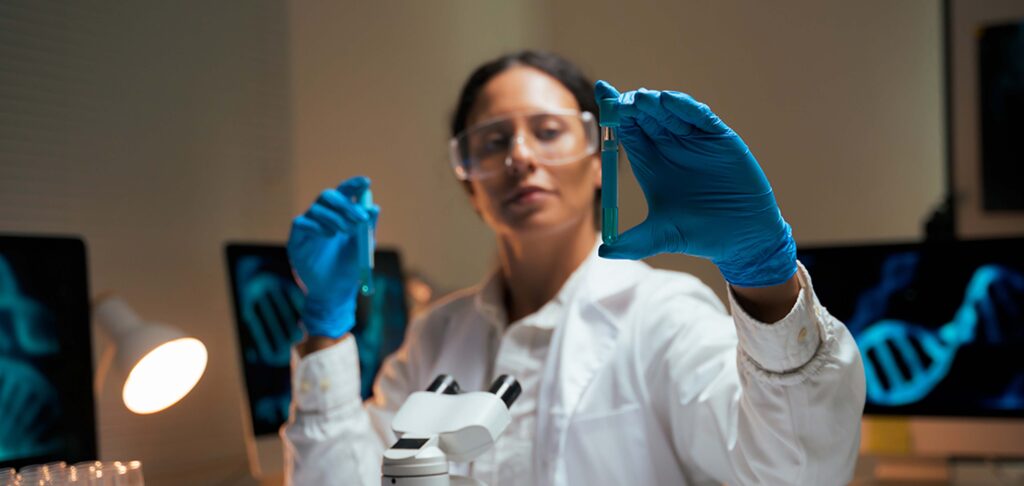
Biomedical Sciences

Postgraduate Program | School of Science

Biomedical Sciences

Biomedical Sciences at Zewail City offers a research-driven postgraduate pathway designed to prepare students for advanced careers in biomedical research, biotechnology, and healthcare-related fields. The program builds strong foundations in molecular biology, genetics, immunology, and computational biology, supported by interdisciplinary research and advanced laboratory training.

Students gain hands-on experience in modern biomedical research and develop the analytical and experimental skills required to address complex scientific and medical challenges.

Why Study This Program

at Zewail City?

  • Access to advanced research facilities, including the Helmy Institute for Medical Sciences
  • Strong focus on interdisciplinary and research-based learning
  • Faculty mentorship by leading researchers in biomedical fields
  • Exposure to academic, clinical, and industrial research environments
  • Training in scientific communication, research methods, and publication

Key Areas of Study

  • Molecular and Cell Biology
  • Cancer Biology
  • Medical Genetics and Genomics
  • Microbiology and Immunology
  • Stem Cells and Regenerative Medicine
  • Chemical Biology and Drug Design
  • Computational Biology

Available Degrees

M.Sc. in Biomedical Sciences

Program Information
Degree Type:
M.Sc.
Study Mode:
Full Time
Duration:
2-4 Years
Total Credit Hours:
40
Language of Study:
English
School:
School of Science
Program Overview

The M.Sc. in Biomedical Sciences is a research-based program designed to develop advanced knowledge and research skills across key biomedical disciplines. The program combines core coursework with specialized study and hands-on laboratory research, enabling students to build expertise in selected concentration areas.

Students are trained in experimental design, data analysis, and scientific communication, preparing them to conduct independent research and contribute to advancements in biomedical sciences.

Program Educational Objectives

Within a few years of graduation, graduates are expected to:

  • Apply advanced knowledge in specialized biomedical fields
  • Design and conduct research using appropriate methodologies
  • Analyze and interpret scientific data
  • Communicate research outcomes effectively

Upon completion of the program, graduates will be able to:

  • Formulate research questions and develop experimental approaches
  • Conduct independent research and analyze results
  • Critically evaluate scientific literature
  • Communicate findings through professional scientific formats
  • Apply ethical standards in biomedical research

The program includes intensive research training through laboratory work, experimental techniques, and scientific analysis. Students work under faculty supervision to conduct independent research in their chosen specialization.

The program culminates in a thesis, where students address a defined research problem and contribute to scientific knowledge through structured investigation and analysis.

Graduates of the Biomedical Sciences program may pursue:

  • Academic and research careers in universities and research institutions
  • Roles in pharmaceutical and biotechnology industries
  • Research and development in healthcare, diagnostics, and drug design
  • Positions in medical and industrial laboratories
  • Careers in data analysis and computational biology
  • Scientific communication, policy, and advisory roles

Ph.D. in Biomedical Sciences

Program Information
Degree Type:
Ph.D.
Study Mode:
Full Time
Duration:
Approximately 5 Years
Total Credit Hours:
60
Language of Study:
English
School:
School of Science
Program Overview

The Ph.D. in Biomedical Sciences is a research-intensive program designed to develop independent researchers capable of advancing knowledge across specialized biomedical fields. The program focuses on developing critical thinking, advanced research methodologies, and scientific innovation.

Students conduct original research based on a well-defined problem, supported by a structured research plan and supervised by a faculty research committee.

Program Learning Outcomes

Upon completion of the program, graduates will be able to:

  • Conduct independent and original research in biomedical sciences
  • Develop and test scientific hypotheses using advanced methodologies
  • Critically analyze scientific literature and research data
  • Contribute to scientific knowledge through publications
  • Communicate research findings effectively in academic and professional settings
  • Lead research projects in multidisciplinary environments

Computer Engineering

This specialization focuses on advanced computing systems, embedded platforms, and secure digital infrastructures. Students gain expertise in computer architecture, operating systems, embedded systems, computer networks, cybersecurity, and intelligent computing systems.

Career Opportunities:

  • Computer Engineer
  • Embedded Systems Engineer
  • Systems Engineer
  • Cybersecurity Engineer
  • Software Systems Engineer
  • IoT Engineer

Communications Engineering & AI

This specialization focuses on modern communication systems and intelligent networking technologies. Students develop expertise in signal processing, communication system modeling, secure network architectures, and IoT platforms. The track also integrates artificial intelligence and data analytics to optimize communication systems and improve network performance.

Career Opportunities:

  • Telecommunications Engineer
  • Network Systems Engineer
  • Signal Processing Engineer
  • Wireless Communications Engineer
  • AI Communications Engineer
  • IoT Systems Engineer

Nanophotonics and Optical Systems

This specialization focuses on light-based technologies and their applications in communication, sensing, and advanced imaging systems. Students explore optical communication systems, fiber optics, laser technologies, and photonic sensors used in modern industries.

Career Opportunities:

  • Photonics Design Engineer
  • Optical Systems Engineer
  • Optical Communications Engineer
  • Laser Applications Engineer
  • LiDAR Systems Engineer

Micro-Electro-Mechanical Systems (MEMS)

This specialization focuses on micro-scale systems that combine electronic and mechanical components such as sensors and actuators. Students gain both theoretical and hands-on experience in MEMS design, fabrication, and applications across industrial, medical, and smart technologies.

Students also benefit from advanced facilities, including the educational cleanroom, where they learn device fabrication processes and microfabrication techniques.

Career Opportunities:

  • MEMS Engineer
  • Sensor Design Engineer
  • Microfabrication Engineer
  • Semiconductor Process Engineer
  • Biomedical Device Engineer

Graduates may work across industries including semiconductor manufacturing, automotive, telecommunications, healthcare technologies, and aerospace.

VLSI and Integrated Circuit Design

This specialization focuses on the design and development of integrated circuits used in modern electronic systems. Students gain knowledge in digital and analog circuit design, chip architecture, and semiconductor technologies. These skills are essential for developing smart devices, artificial intelligence hardware, communication systems, and advanced computing platforms.

Career Opportunities:

  • Circuit Design Engineer
  • Physical Design Engineer
  • Verification Engineer
  • ASIC Design Engineer
  • Semiconductor Engineer
Young Learners Programs

Seasonal programs designed to build skills and spark curiosity across different age groups.

  • Ages 18–25 | 30 hours – ZC Job Readiness Program

    Focuses on employability skills including communication, professionalism, digital skills, financial awareness, and entrepreneurship.
  • Ages 7–12 & 13–15 | 5 days – Young Scientist Camp

    Hands-on scientific learning with Zewail City professors and researchers, designed to inspire early interest in science and innovation.
Language Programs

Professional language courses designed to strengthen communication in workplace environments.

  • Business English
  • Legal English
Continuing Education

AI Specialized Short Courses

10–15 hours each. Practical AI tools tailored to different professions.

  • AI Tools for Engineers (Mechanical, Architecture, Petroleum)
  • AI Tools for HR Professionals
  • AI Tools for Office Managers & Administrators
  • AI Tools for Accountants & Finance Professionals
  • AI Tools for Bankers
  • AI Tools for Teachers
  • AI Tools for Instructional Designers

Professional Diploma in Data Analysis

180 hours | Micro-credential based

A comprehensive diploma covering:

  • Statistics & Excel for Data Analysis
  • Power BI (Basic to Advanced)
  • Databases & SQL
  • Programming Concepts
  • Python for Data Analysis (Fundamentals to Advanced Applications)

Modules can be taken individually or as a complete professional diploma track.

Corporate Training

Corporate Training & Tailored Programs

Fully customized programs developed in partnership with organizations to address specific capability gaps and performance priorities.

Each program is designed following a deep assessment of organizational objectives, talent needs, and strategic goals, ensuring measurable impact and sustainable outcomes.

  • Performance Analysis
  • Talent Assessment
  • Strategic Goals
Executive Education Programs

Short, focused programs designed to build practical leadership, analytical, and business skills.

  • Data-Driven Decision Making
  • Business Psychology
  • HR Analytics using Excel & Power BI
  • International Financial Reporting Standards (IFRS) – Part 1 (25 hours)
  • International Financial Reporting Standards (IFRS) – Part 2 (25 hours)
  • Finance for Non-Finance Professionals (25 hours)